
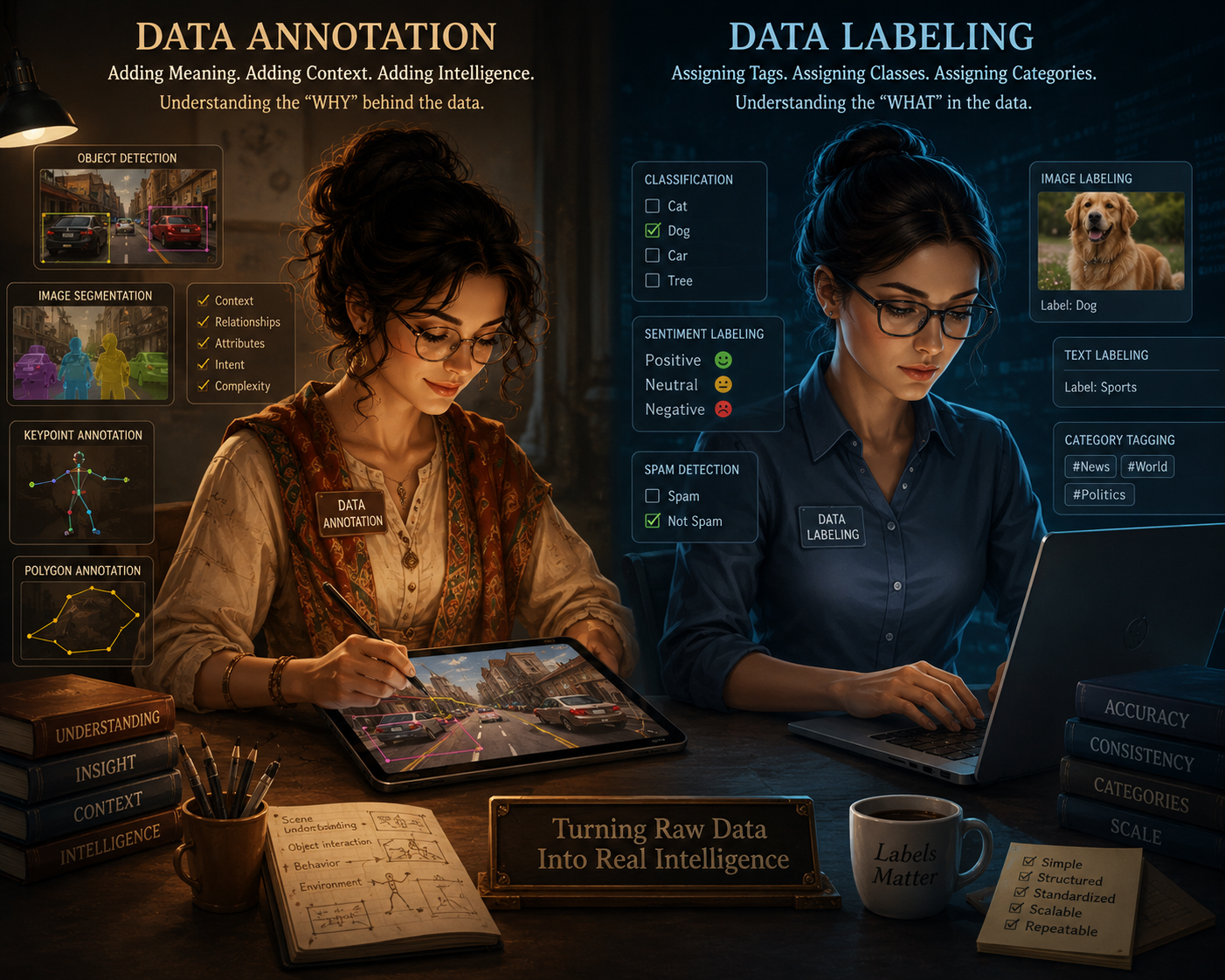
Data is considered sometimes more relevant than information and knowledge itself. It is the hidden foundation of Artificial Intelligence, which is termed to be one of the most constructive as well disruptive technologies of the age we are passing. Voice Assistant, Chatbots, Self-driving Cars, Medical Diagnosis systems and a host of others have become inevitable we cannot ignore and DATA ANNOTATION & Data Labeling is an integral part of Masnui Zahanat (MZ – AI).
Data labeling is defined as a process for figuring out titles, tags, classification or categorization of raw data for a machine to learn whereas Data Annotation means assigning tags in addition to contextual information to data so that electronic devices such as computer may understand patterns, objects, language sounds, human behaviors and others.
To understand by analogy, suppose we are to develop an AI System to recognize images of monuments in the subcontinent as to whether they are Islamic or Hindu Sanatani themed, we are required to label thousands of monument images, adding features, classification and so on. In case of a natural language, label words, terms, expressions, sentences, emotions, entities and intentions with others in textual data to teach chatbots and language models.
Data annotation may be in a number of forms. Image annotation comprises of facial recognition, autonomous vehicles, whereas text annotation helps in sentiment analysis and machine translation. Audio annotation helps train speech recognition systems, and video annotation is essential for surveillance, robotics, and traffic analysis.
The rapid expansion of AI has also created a global workforce dedicated to annotation tasks. Millions of workers across countries such as India, the Philippines, Kenya, and other developing regions participate in data labeling projects through remote platforms. These jobs provide flexible work opportunities and have become an important entry point into the digital economy.
To improve efficiency, many organizations are now adopting AI-assisted annotation systems where pre-trained models suggest labels that humans verify or correct. Technologies such as active learning and synthetic data generation are also reducing manual workloads. Nevertheless, human judgment remains essential because machines still struggle with ambiguity, cultural understanding, ethics, and contextual reasoning. (Hamid Siddiqui)


Leave a Reply