
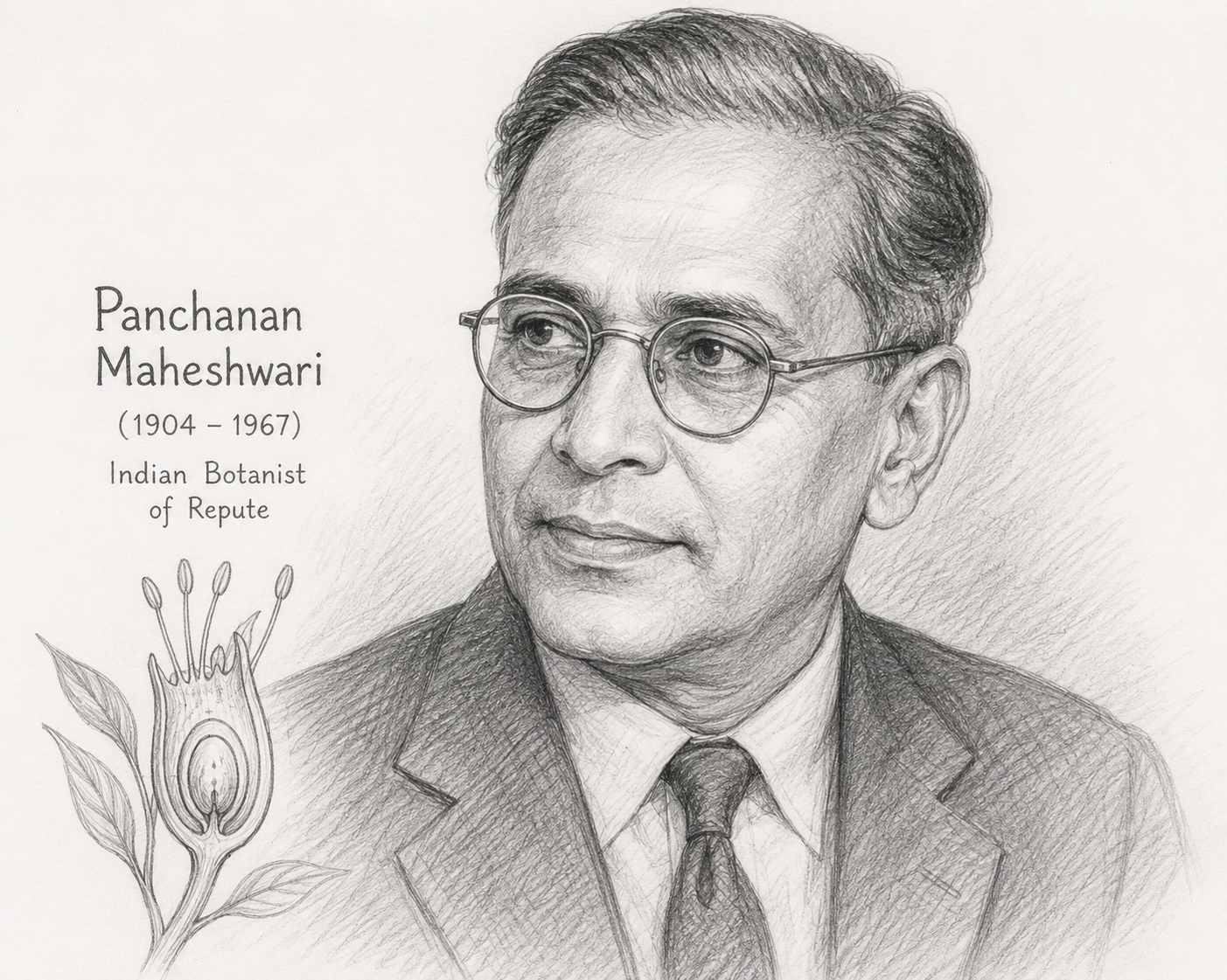
Panchanan Maheshwari born in 1904 and died in 1966 was born in Jaipur Rajasthan. An alumnus of Ewing Christian College, Allahabad, he was inspired by Dr W. Dudgeon, an American missionary teacher, to develop interest in Botany and especially morphology. He worked on embryological aspects and popularized the use of embryological characters in taxonomy. He established the Department of Botany, University of Delhi as an important centre of research in embryology and tissue culture. He also emphasized the need for initiation of work on artificial culture of immature embryos. These days, tissue culture has become a landmark in science. His work on test tube fertilization and intra-ovarian pollination won worldwide acclaim.
Panchanan Maheshwari was honored with fellowship of Royal Society of London (FRS), Indian National Science Academy and several other institutions of excellence. He encouraged general education and made a significant contribution to school education by his leadership in bringing out the very first textbooks of Biology for Higher Secondary Schools published by NCERT in 1964.
Regarded as the Father of Modern Plant Embryology in India, Panchanan Maheshwari carried out extensive research in plant embryology particularly in angiosperms, studied the development of embryo, embryo sac, ovule and seeds developing techniques for the artificial culture of ovules and embryos in laboratories. He worked tirelessly to establish embryology as an important branch of botany in India. He trained a number of future botanists in India while serving as a Professor at the University of Delhi. Indeed Panchanan Maheshwari is a role model for Indians in the field of Botany. (Mohammad Umar Siddiqui, Last Year Student of MBBS in Trichy, Tamil Nadu).
Below I reproduce the story of Panchanan Maheshwari and his worthy son Satish Chandra Maheshwari as posted in Reddit for those persons who are interested in their lives and works:

“The story of Panchanan Maheshwari and his son Satish Chandra Maheshwari represents one of the most remarkable father-son duos in the annals of Indian Science. Their combined contributions to botany, particularly in the fields of plant embryology, physiology, and molecular biology, have left an indelible mark on both national and international scientific landscapes. Panchanan, often hailed as the father of Indian plant embryology, laid the foundational stones for systematic research in plant reproductive biology in India during the mid-20th century. His son, Satish Chandra, built upon this legacy, venturing into modern realms of plant molecular biology and pioneering techniques that revolutionized crop improvement and genetic engineering. Together, they embody the spirit of scientific inquiry, mentorship, and innovation that has inspired generations of researchers across the globe.
The Early Years of Panchanan Maheshwari:
Panchanan Maheshwari was born on November 9, 1904, in Jaipur, Rajasthan, into a modest middle-class family during the waning years of British Colonial rule in India. His father, Vijaypal, worked in a clerical position in the princely state’s administration, and the family environment, while respectful of education, was not particularly inclined toward advanced academia or scientific research. The India of Panchanan’s youth was undergoing significant social and political upheaval, with the independence movement gaining momentum and traditional educational systems being challenged by modern Western influences. However, young Panchanan’s curiosity about the natural world was evident early on, manifesting in his fascination with the diverse flora surrounding Jaipur and the Aravalli hills.
He received his initial education in local schools in Jaipur before moving to Allahabad for higher studies at Ewing Christian College, one of the premier educational institutions in northern India at the time. Initially aspiring to a career in medicine—a common ambition among bright students of that era—Panchanan shifted his focus to botany under the influence of his mentor, Professor Winfield Dudgeon, an American botanist who had come to India as part of the Christian missionary educational movement. Dudgeon recognized Panchanan’s exceptional potential and keen observational skills, qualities essential for botanical research. This mentorship proved pivotal, as Dudgeon not only guided Panchanan academically through the intricacies of plant morphology and anatomy but also fostered a deep passion for understanding the fundamental processes of plant life, particularly reproduction.
Panchanan’s academic trajectory was meteoric. He earned his Bachelor of Science degree in 1925 with distinction, followed by a Master of Science in 1927, both from Allahabad University. His master’s thesis already showed signs of his future specialization, focusing on detailed anatomical studies of flowering plants. He then embarked on doctoral research, completing his Doctor of Science degree in 1931 from the same institution. His doctoral work focused on the morphology and embryology of angiosperms, meticulously documenting the developmental stages of plant embryos and the formation of reproductive structures. This early work set the stage for his lifelong dedication to this field and established his reputation as a thorough and innovative researcher.
Building a Career amidst National Transformation Post-doctorate, Panchanan joined the faculty at Agra College in 1931, where he began establishing his own research program despite limited resources. The 1930s and 1940s were challenging times for scientific research in India, with most institutions lacking adequate laboratory facilities, equipment, and funding. Nevertheless, Panchanan’s determination and ingenuity allowed him to conduct meaningful research. He later moved to Dacca University (now in Bangladesh) in 1937, where he was appointed as a professor and began building a research group focused on plant embryology. During his time in Dacca, he supervised several doctoral students and published extensively in international journals, gradually gaining recognition in the global botanical community.
The partition of India in 1947 was a traumatic event that affected millions, including the Maheshwari family. The violent upheaval forced Panchanan and his family to relocate from Dacca to Delhi, leaving behind the institution he had helped build. However, this displacement turned into an opportunity when he was appointed as a professor and head of the Department of Botany at the University of Delhi in 1949. This appointment marked the beginning of a golden era for botany in India and the true flowering of Panchanan’s vision for plant science research and education.
Revolutionary Contributions to Plant Embryology:
Panchanan’s contributions to plant embryology were groundbreaking and multifaceted. He is credited with developing the technique of test-tube fertilization of angiosperms, a method that allowed for the in vitro cultivation of plant embryos. This innovation opened new avenues for studying plant reproduction under controlled conditions, bypassing natural barriers such as incompatibility mechanisms and enabling detailed observations of developmental processes that were previously impossible to study. The technique involved carefully dissecting developing ovules, culturing them in nutrient media, and observing the sequential stages of embryo development. This work predated and paralleled similar developments in animal embryology and tissue culture.
His comprehensive work on the embryology of over 100 families of angiosperms and several gymnosperms provided unprecedented insights into the reproductive strategies of seed plants. Panchanan’s research elucidated complex phenomena such as endosperm development, the nutritive tissue that supports embryo growth; seed formation and dormancy mechanisms; polyembryony, where multiple embryos develop in a single seed; and the role of various cellular structures in fertilization, including the synergids, antipodals, and other components of the female gametophyte. His detailed comparative studies revealed evolutionary patterns and relationships among different plant groups, contributing to our understanding of angiosperm phylogeny.
One of Panchanan’s most significant contributions was his synthesis of global knowledge in plant embryology. He was a voracious reader of scientific literature and maintained extensive correspondence with botanists worldwide, despite the communication challenges of the pre-internet era. His monograph “An Introduction to the Embryology of Angiosperms” published in 1950 by McGraw-Hill, became the definitive textbook on the subject and was used by students and researchers globally for decades. The book was remarkable for its clarity, comprehensive coverage, and beautiful illustrations, many drawn by Panchanan himself. It went through multiple editions and translations, cementing his status as the leading authority on plant embryology.
Institution Building and Educational Reform
Beyond his laboratory achievements, Panchanan was a visionary educator and institution builder who understood that scientific progress required strong institutional foundations. He transformed the Botany Department at Delhi University into a world-class center for plant morphology and embryology, attracting scholars from around the globe. He secured funding for modern microscopes, microtomes, and other equipment essential for cytological research. His laboratory became a hub of activity, with students and visitors from across India and abroad coming to learn embryological techniques and discuss research.
Recognizing the need for international collaboration and communication, Panchanan founded the International Society of Plant Morphologists in 1951, creating a platform for botanists worldwide to share their research and ideas. He launched the journal Phytomorphology in the same year, which quickly became a premier platform for publishing research in plant developmental biology, anatomy, and morphology. Panchanan served as the editor of Phytomorphology for many years, personally reviewing manuscripts and maintaining high scientific standards. The journal provided an important outlet for Indian scientists to publish their work and gain international recognition.
Additionally, he edited “Recent Advances in the Embryology of Angiosperms,” published in 1963, a seminal volume that compiled global progress in the field. This book featured contributions from leading embryologists worldwide and represented the state of knowledge at that time. It covered topics ranging from megasporogenesis and megagametogenesis to fertilization, endosperm development, and embryogenesis, with chapters written by specialists in each area.
Panchanan’s commitment to education extended beyond the university to school levels. He firmly believed that science education needed to start early and be grounded in observation and experimentation rather than rote memorization. He was deeply concerned about the state of science education in Indian schools, which he felt relied too heavily on memorization of facts without understanding underlying principles or developing critical thinking skills. He led the development of the first biology textbooks for higher secondary schools published by the National Council of Educational Research and Training (NCERT) in 1964, standardizing and elevating biology education across India.
These textbooks represented a revolutionary approach to biology education in the Indian context. They introduced modern concepts and experimental approaches to biology teaching, incorporating recent discoveries and emphasizing the scientific method. Panchanan insisted on including practical exercises and observations that students could perform themselves, believing that hands-on experience was crucial for understanding biological concepts. The textbooks covered topics from cell biology to ecology, presenting them in an integrated manner that helped students see connections across different areas of biology. They included detailed illustrations, many adapted from his own research publications, and discussion questions that encouraged critical thinking rather than mere regurgitation of facts.
The impact of these textbooks was profound and long-lasting. They influenced generations of students and helped create a more scientifically literate populace. Many students who used these books went on to pursue careers in biology and related fields, citing the textbooks as instrumental in sparking their interest in science. The NCERT biology textbooks also served as models for textbook development in other subjects and influenced educational reform efforts across India. Panchanan’s vision of making science education accessible, engaging, and intellectually rigorous continues to inspire educational initiatives today.
International Recognition and Impact:
Panchanan’s international recognition came through numerous fellowships and honors, reflecting the global impact of his work. He was elected as a Fellow of the Royal Society (FRS) in 1965, making him one of the few Indian scientists to achieve this distinction at the time. The FRS is one of the highest honors a scientist can receive, and Panchanan’s election was a testament to his groundbreaking contributions to plant biology. He was also elected as a fellow of the Indian Academy of Sciences, the Indian National Science Academy, and the National Academy of Sciences, India. He received honorary doctorates from several universities and was invited to deliver prestigious lectures at institutions worldwide.
Panchanan’s work not only placed India on the global botanical map but also trained a cadre of students who carried forward his legacy. Among his notable students were B.M. Johri, who became a leading embryologist in his own right; G.L. Chopra, who worked on pollen development; and P.S. Srivastava, who later pioneered plant tissue culture in India. Many of his students went on to establish their own research groups and departments, spreading Panchanan’s approaches and values across Indian universities. This multiplier effect meant that his influence extended far beyond his direct publications.
Tragically, Panchanan passed away on May 18, 1966, from encephalitis, at the age of 61, leaving behind a profound void in the scientific community. His death came just a year after his election to the Royal Society, cutting short what might have been many more years of productive research and mentorship. The Indian scientific community mourned the loss of one of its brightest stars, and obituaries in international journals testified to his global stature.
Satish Chandra Maheshwari:
Carrying the Torch Forward
Satish Chandra Maheshwari, born on October 4, 1933, in Jaipur, grew up in the shadow of his father’s illustrious career, but rather than being intimidated, he drew inspiration and guidance from it. The Maheshwari family, which included Satish’s siblings—brothers Ramesh (who also became a botanist specializing in mycology) and others—moved frequently due to Panchanan’s academic postings, from Jaipur to Allahabad, Dacca, and finally Delhi after independence in 1947. This nomadic early life exposed Satish to diverse environments and different educational systems, nurturing his adaptability and interest in biology. Growing up in a household where scientific discussions were common and visiting scholars from around the world were frequent guests, Satish developed a deep appreciation for scientific inquiry from an early age.
He completed his schooling in Jaipur and Dacca before enrolling at St. Stephen’s College, University of Delhi, for his bachelor’s degree in botany honors. St. Stephen’s was and remains one of India’s most prestigious undergraduate institutions, known for its rigorous academic standards and liberal arts approach. After completing his bachelor’s degree in 1952, he pursued his master’s and PhD at the same university, working on the embryology of duckweeds (Lemnaceae) under the supervision of B.M. Johri, a close associate and former student of his father. This arrangement was both advantageous and challenging—advantageous because Johri was an excellent mentor who had imbibed Panchanan’s methods, and challenging because Satish felt the pressure to live up to his father’s reputation.
Early Research and International Exposure
Satish’s doctoral research on Lemnaceae (duckweeds) yielded significant findings that established his reputation as a meticulous researcher in his own right. He published papers in Nature, one of the world’s most prestigious scientific journals, on the endosperm and seed structure of Wolffia microscopica, one of the smallest angiosperms known. These publications demonstrated that despite their highly reduced morphology, duckweeds retain fundamental embryological features that reveal their evolutionary relationships. Satish demonstrated the close relationship between Lemnaceae and Araceae (the arum family), providing evolutionary insights that were later confirmed by molecular phylogenetic studies. His work showed that duckweeds represent a highly derived lineage that had undergone extreme reduction associated with their aquatic lifestyle.
Post-PhD, Satish joined the faculty at Delhi University in 1954, initially following closely in his father’s footsteps in embryological research. However, he soon received a Fulbright Fellowship to conduct postdoctoral research at Yale University and the California Institute of Technology from 1959 to 1961. This experience abroad during the golden age of molecular biology proved transformative. At Yale and Caltech, Satish was exposed to cutting-edge techniques in biochemistry and molecular biology that were just beginning to revolutionize biological research. It was during this period that he discovered RNA polymerase activity in chloroplasts, revealing the presence of DNA in these organelles. This finding was part of the broader discovery of organellar genomes, a key step toward understanding how chloroplasts and mitochondria evolved from ancient bacterial endosymbionts. This work helped establish the field of organelle genetics and had profound implications for understanding cellular evolution.
Pioneering Plant Tissue Culture in India
Returning to India in 1961, Satish shifted his focus from classical embryology to plant physiology and molecular biology, recognizing that the future of plant science lay in understanding the molecular mechanisms underlying development. In 1966, collaborating with his wife, Sipra Guha Mukherjee (also a talented plant scientist), he developed the anther culture technique for producing haploid plants from pollen grains of Datura innoxia. This breakthrough method, now widely used for crop improvement worldwide, allows for the rapid generation of homozygous lines through chromosome doubling of haploids. Traditional breeding requires multiple generations of selfing to achieve homozygosity, but anther culture can accomplish this in a single step, dramatically accelerating breeding programs for horticultural and ornamental plants, as well as agricultural crops.
The anther culture technique involves culturing anthers containing developing pollen on specially formulated nutrient media. Under appropriate conditions, some pollen grains undergo embryogenesis rather than gametogenesis, developing into haploid plants. These can then be treated with colchicine or other agents to induce chromosome doubling, producing completely homozygous diploid plants. Satish and Sipra’s work opened up new possibilities for plant breeding and genetic improvement, and they trained numerous students in these techniques. Their laboratory became a center for plant tissue culture in India, much as Panchanan’s had been for embryology.
Advancing Plant Molecular Biology and Physiology
Satish’s research program expanded to encompass multiple areas of plant biology. His work on plant growth hormones led to the development of protocols for isolating and purifying cytokinins and gibberellins, two important classes of plant growth regulators. He elucidated the role of salicylic acid in flowering, demonstrating that this simple compound could influence the transition from vegetative to reproductive growth. His research on phytochrome control of metabolism advanced our understanding of how light influences plant development through this photoreceptor pigment. He showed how phytochrome regulates the expression of specific genes and metabolic pathways, linking environmental signals to developmental responses.
In the 1980s, recognizing the growing importance of molecular approaches, Satish son of Panchanan founded the Department of Plant Molecular Biology at Delhi University, the first department of its kind in India. This was a bold and visionary move that positioned Indian plant science to participate in the emerging genomics revolution. He established a unit for Plant Cell and Molecular Biology equipped with modern facilities for DNA and protein analysis. Under his leadership, researchers in this department conducted pioneering studies on rice chromosomes and DNA sequencing, contributing to early efforts in plant genomics. They also worked on understanding stress responses in plants at the molecular level, identifying genes involved in drought, salinity, and temperature stress tolerance.
International Stature and Mentorship:
Satish’s international stature grew through visiting positions at Oxford, Harvard, and Yale, where he collaborated with leading scientists and stayed abreast of the latest developments in plant molecular biology. He was awarded the prestigious Homi Bhabha Fellowship, India’s highest honor for scientists, which allowed him to pursue research of his choice.
Thus, India owes a lot to Panchanan Maheshwari and his family who have done a good job in the field of science for Indians in particular and for the humanity at large.
(Mohammad Umar Siddiqui, Last Year Student of MBBS in Trichy, Tamil Nadu).
Leave a Reply