
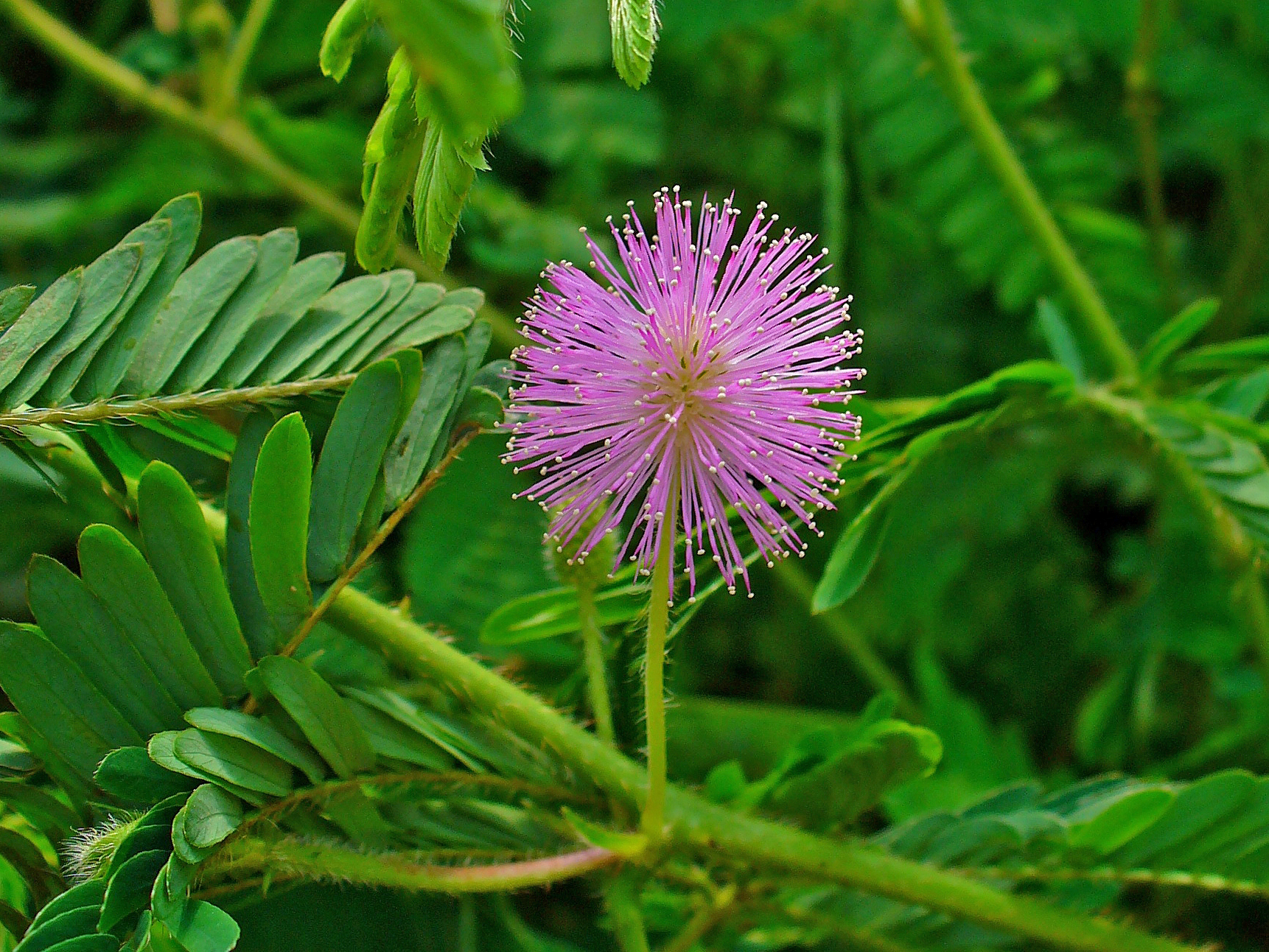
Lajjawati is a fascinating plant whose binary nomenclature is Mimosa pudica. Both terms of Mimosa and pudica are derived from Latin language. Mimosa means ‘mimic’ i.e. imitator meaning thereby actor/actress and the pudica signifies to modest, shy (Sharmili – Sharmila and chaste etc, so the literal connotation of Mimosa pudica is Sharmili Adakar and it is called in Nepali dialect as Lajjawati and I admire this plant because this has poetic name as well as poetic features.
Botanically, Lajjawati is a perennial and creeping annual herb in the Fabaceae family, whose clades that we can understand as a group of organisms which share a common ancestor, forming a branch of the evolutionary tree, are Tracheophytes, Angiosperms, Eudicots and Rosids in the kingdom of plants. Its order is Fabales and subfamily being casalpiniodeae having clade of mimosoid its genus is mimosa and species M. pudica. Native to South America and Central America, this is widely found in tropical regions and often grows as a weed in lawns and along roadsides.
The appearance of Lajjawati is fern-like, compound leaves with small, green leaflets and pink, ball-shaped flowers that bloom from summer to fall. The plant typically grows 15–100 cm tall, with a prickly stem. Its leaves exhibit rapid movement like Regional Rapid Transit System in Delhi & Delhi NCR on which Namo Bharat runs.
Lajjawati is known by diverse names and epithets in various languages and cultures. Sensitive plant, sleepy grass, sleepy plant, action plant, humble plant, touch-me-not, touch-and-die and shame plant are some English names, whereas they address it as Chhuyee Muyee (छुईमुई) in Hindi and Urdu that reflect the unique behavior of Mimosa pudica.
Lajjawati behaves uniquely, so it is the subject of study for plant movement, sensory biology, and environmental adaptation, thigmotropism (touch response) as its leaves fold inward and droop in case it is touched, shaken or exposed to heat. These movements are called nyctinastic or seismonastic movements that occur within seconds. The response is triggered by mechanical stimuli, which cause changes in turgor pressure in specialized cells (pulvini) at the base of leaflets and leaf stalks. Potassium ions move out of these cells, leading to water loss and collapse of the leaf structure. The plant reopens its leaves within 15–30 minutes as turgor pressure is restored. Another feature is Nyctinastic Movement (Sleep Movement). At night, Lajjawati closes its leaves, a behavior driven by circadian rhythms and light changes. This reduces water loss and may protect against herbivores or environmental stress. The movement is also controlled by the pulvini and ion exchange, similar to the touch response. Its defensive behavior also is interesting. The rapid leaf closure is thought to deter herbivores by mimicking the appearance of a wilted or less palatable plant or startling small animals/insects. This modest plant responds to other stimuli like temperature, wind, or chemical changes. For example, high heat can trigger leaf closure to minimize water loss. It thrives in warm, humid environments and may show reduced sensitivity in colder or drier conditions.
Lajjawati produces small, pink, ball-shaped flowers that attract pollinators. After pollination, it forms seed pods that can burst open, dispersing seeds. – Seeds have a hard coat, allowing dormancy and germination under favorable conditions. This is a low-growing, creeping plant, often considered a weed in tropical and subtropical regions. Its sensitivity to touch may aid in colonizing disturbed areas by deterring grazing. It can fix nitrogen through root nodules, enhancing soil fertility and supporting its growth in nutrient-poor soils.
As I have mentioned above that Mimosa pudica has been honored by a poetic name and our poets like Meer Taqi Meer have always admired beautiful plants for appearance, but Lajjawati goes ahead and acts like Sharmili (Sharmila) Tagore, the heroine of Kashmir Ki Kali and grandmother of Taimur and Jeh (Jahangeer). (Hamid Siddiqui) ΩΩΩ
Fankar Academy, Budaun
Qrat a Computer Group
Rang Birangi Dunya
BRONICKA – AS AN AGI LEGEND!


Leave a Reply